Why having a PAN card is so important - Business Today

Monday, November 9, 2020 | Updated 20:28 IST
Tax Identity
We tell you all you need to know about your PAN, or Permanent Account Number, and why it is so important
Print Edition: July 2013
PAN, or permanent account number, is a unique 10-digit alphanumeric identity allotted to each taxpayer by the Income Tax Department under the supervision of the Central Board of Direct Taxes. It also serves as an identity proof. PAN is mandatory for financial transactions such as receiving taxable salary or professional fees, sale or purchase of assets above specified limits, buy mutual funds and more.
The primary objective of PAN is to use a universal identification key to track financial transactions that might have a taxable component to prevent tax evasion. The PAN number remains unaffected by change of address throughout India.
WHO MUST APPLY FOR PAN?
- Anybody who earns a taxable income in India, including foreign nationals who pay taxes here
- Anybody who runs a business (be it retail, services or consultancy) that had total sales, turnover or gross receipt exceeding Rs 5 lakh in the previous financial year
HOW TO APPLY?
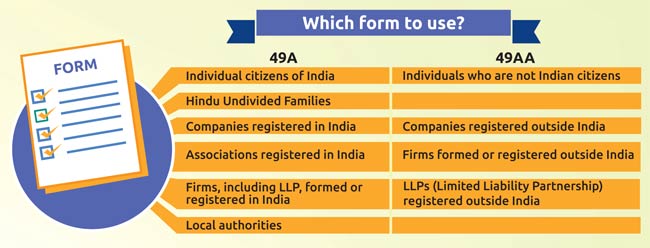
- Use 'Form 49A' or 'Form 49AA' as applicable to you. Find more details at incometaxindia.gov.in.
- You can find the location of PAN card offices in any city from the websites of the Income Tax Department or National Securities Depository Limited (NSDL).
- You will need copies of proof of Identity and address.
- Payment can be made using cash, cheque or demand draft.
- You can also apply online through websites of the I-T Department or NSDL.
- If you are applying online, the processing fee can be paid via net banking, credit card or debit card.
- Track the status of your application online.
WHY GET A PAN NUMBER?
- For payment of direct taxes
- To file income tax returns
- To avoid deduction of tax at higher rate than due
- To enter into specific transaction such as:
(b) Sale or purchase of a vehicle other than a two wheeler
(c) Payment to hotels or restaurants an amount exceeding Rs 25,000 at any one time
(d) Payment in cash an amount exceeding Rs 25,000 in connection with travel to any foreign country
(e) Payment of an amount of Rs 50,000 or more to the Reserve Bank of India for acquiring bonds
(f) Payment of an amount of Rs 50,000 or more to a company or an institution for acquiring bonds or debentures
(g) Payment of an amount of Rs 50,000 or more to a company for acquiring shares
(h) Any mutual fund purchase
(j) Deposit exceeding Rs 50,000 with any single banking institution in 24 hours.
(k) Payment exceeding Rs 5 lakh for purchase of bullion and jewellery
Source: Incometaxindia.gov.in
DO YOU LIKE THIS STORY?
 238
238  45
45
238 45

 BioNTech, Pfizer stocks skyrocket after COVID vaccine shows over 90% efficacy
 US Wall Street set to jump after Biden election win
 Pfizer, BioNTech COVID-19 vaccine found 90% effective in fighting virus
 BHEL share falls 2% after firm logs Rs 552-cr loss in Q2
 Sensex, Nifty close at record highs as Joe Biden wins US election
 Reliance Jio Prime vs Airtel, Vodafone, Idea 4G offers
 Reliance Jio plans to bring 5G internet to your smartphones
 Maruti Suzuki opens online booking for Baleno RS
 India Inc to get 9.5 per cent salary hike this year
 Five tips to get a good salary hike this year
 Google India faces fresh antitrust charges from CCI over market abuse, Google Pay promotion
 Best under Rs 25,000 phones to buy this Diwali: vivo V20 SE, OnePlus Nord, Realme 7 Pro make the cut
 Women and transgender community turn to Phree app to identify safe places in Delhi
 Samsung may launch Galaxy S21 early, launch date likely to be January 14
 Apple iPhone 12 Studio lets you virtually try out MagSafe accessories on iPhone 12

Comments
Post a Comment